Hypertonic Saline for COPD and Bronchiectasis: Benefits and How Often to Use It
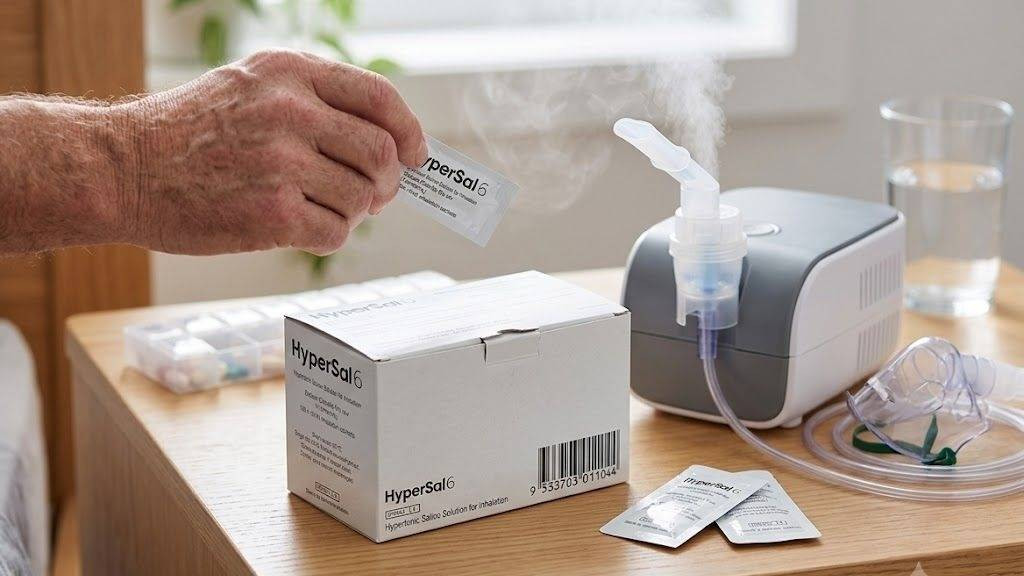
For patients managing chronic lung disease, hypertonic saline at 6% sodium chloride concentration — such as HyperSal6 — loosens thick mucus, reduces airway inflammation, and improves mucus clearance in COPD and bronchiectasis. Working by osmosis, it draws water into airway secretions so they can be cleared more easily. Dosing is typically 1–2 treatments per day as needed, or as directed by a doctor. SuperPharmacyPlus at 621 Stafford Road stocks HyperSal6 in sterile, single-use 10ml sachets (150 per box).
HyperSal6, delivered via nebuliser, supports mucociliary clearance in COPD and bronchiectasis by thinning and loosening airway secretions, reducing bacterial growth and bronchial inflammation. Current guidelines recommend its use for bronchiectasis patients. Frequency varies by clinical need; patients work with their respiratory clinician to establish a consistent daily or twice-daily nebulisation schedule. HyperSal6 is preservative-free and can be diluted with sterile water if a weaker concentration is preferred.
How Does Hypertonic Saline Help COPD and Bronchiectasis?
HyperSal6 nebulised saline for chronic lung disease works by osmosis — drawing water into airway secretions and making thick, sticky mucus easier to clear through coughing and airway-clearance techniques. cite-1 At 6% sodium chloride (w/v), HyperSal6 is a mucoactive treatment — not an antibiotic or bronchodilator — that targets the physical properties of mucus directly. Each sterile, preservative-free, single-use 10ml sachet is poured directly into the nebuliser medicine bowl before use.
Bronchiectasis traps patients in a damaging cycle. Impaired mucociliary transport prevents secretion elimination, which allows bacteria to grow and drives ongoing airway inflammation. Breaking that cycle requires consistent mucus clearance, and hypertonic saline addresses exactly that mechanism.
What type of medication is hypertonic saline?
Do current guidelines recommend hypertonic saline for bronchiectasis?
Current respiratory guidelines recommend saline solution for nebuliser use to facilitate mucociliary clearance in bronchiectasis patients whose condition is not secondary to cystic fibrosis. cite-2 Evidence of efficacy in this population remains limited, so guidelines advise a supervised trial rather than routine use.
HyperSal6 saline for nebuliser is available through SuperPharmacyPlus, a Stafford, Queensland-based pharmacy that ships nationally — ensuring consistent access to the right hypertonic saline dosage frequency and formulation recommended by a treating clinician. HyperSal6 is sold as a box of 150 x 10ml single-use sterile sachets (SKU 16732) and is available for $131.95.
What Are the Benefits and Risks of Nebulised Saline?
How does a nebuliser deliver saline to the lungs?
Who should use hypertonic saline for COPD?
Current European Respiratory Society guidance reserves hypertonic saline for selected patients whose symptoms remain uncontrolled despite personalised airway clearance. Nebulised saline is not a routine treatment for every COPD exacerbation, cough, or asthma flare.
Key risks to discuss with a clinician:
1: Cough, wheezing, or chest tightness during or after inhalation
2: Bronchospasm or oxygen desaturation in susceptible individuals
3: Throat irritation or persistent salty taste affecting long-term adherence
4: Breathlessness (dyspnoea) that discourages consistent use
A high percentage of bronchiectasis patients tolerate HyperSal6 well, yet adverse effects remain common enough to undermine adherence. SuperPharmacyPlus, based in Stafford, Queensland, ships HyperSal6 and clinician-grade nebuliser supplies to COPD patients across Australia, and can assist with product selection and hypertonic saline dosage frequency guidance.
How Often Should You Use Hypertonic Saline for COPD?
Hypertonic saline dosage frequency for COPD and related chronic airway conditions must be directed by a clinician. No standard self-directed schedule exists — concentration, volume, and frequency all depend on the individual patient's condition and response.
Nebulised saline for chronic lung disease is most commonly prescribed for bronchiectasis, a condition where damaged airways trap mucus and become vulnerable to repeated infection. Patients with other lung conditions affecting the airways may also be candidates, but a respiratory specialist determines whether treatment is appropriate.
Who Decides the Right Dosing Schedule?
What Happens If Side Effects Become a Problem?
Adverse effects from hypertonic saline can reduce a patient's willingness to continue treatment. In some cases, side effects are significant enough that treatment must be discontinued entirely. Makes professional monitoring throughout the course of therapy essential.
Key points for COPD patients considering nebulised saline:
1: Dosing is typically 1–2 HyperSal6 treatments per day as needed, or as directed by a doctor
2: HyperSal6 may be diluted with sterile water if a weaker concentration is preferred
3: Only sterile, single-use, inhalation-grade sachets such as HyperSal6 are appropriate — never a preparation not designed for respiratory use
4: Adherence problems linked to side effects require prompt clinical review
Patients across Australia can source HyperSal6 through SuperPharmacyPlus, a Stafford, Queensland-based pharmacy offering national delivery and clinical guidance on chronic lung disease management.
Hypertonic saline therapy represents a valuable therapeutic option for individuals managing COPD. Bronchiectasis, offering meaningful benefits through improved mucus clearance and enhanced airway function. Establishing a consistent usage routine—guided by your healthcare provider's recommendations—ensures optimal outcomes and supports long-term respiratory health. Our pharmacy team stands ready to assist with proper nebuliser setup, technique guidance. Ongoing support as you integrate this treatment into your daily respiratory management plan.
Frequently Asked Questions
What does hypertonic saline do for COPD and bronchiectasis airways?
How often do patients use hypertonic saline nebulisation?
Where do Australian patients source hypertonic saline for their nebuliser?
Conclusion
Recent Posts
-
Sep 14, 2026
What do the added amino acids and soluble fibre bring to BJE100?
BJE100 is BergaMet's new patented citrus bergamot extract, developed over the past two … -
 Sep 12, 2026
Why does Eagle Tresos Natal contain both 5-MTHF and folinic acid?
Eagle Tresos Natal is a one-a-day multivitamin and mineral formula designed to provide … -
 Sep 10, 2026
How does BJE100 differ from the earlier BPF99 bergamot extract?
BJE100 is BergaMet's new patented citrus bergamot extract, developed over the past two …